Can We Trust Deception Monitors for AI Agents?
A Robustness-Gap Protocol and the Limits of Adaptive Evasion
Why I took this on
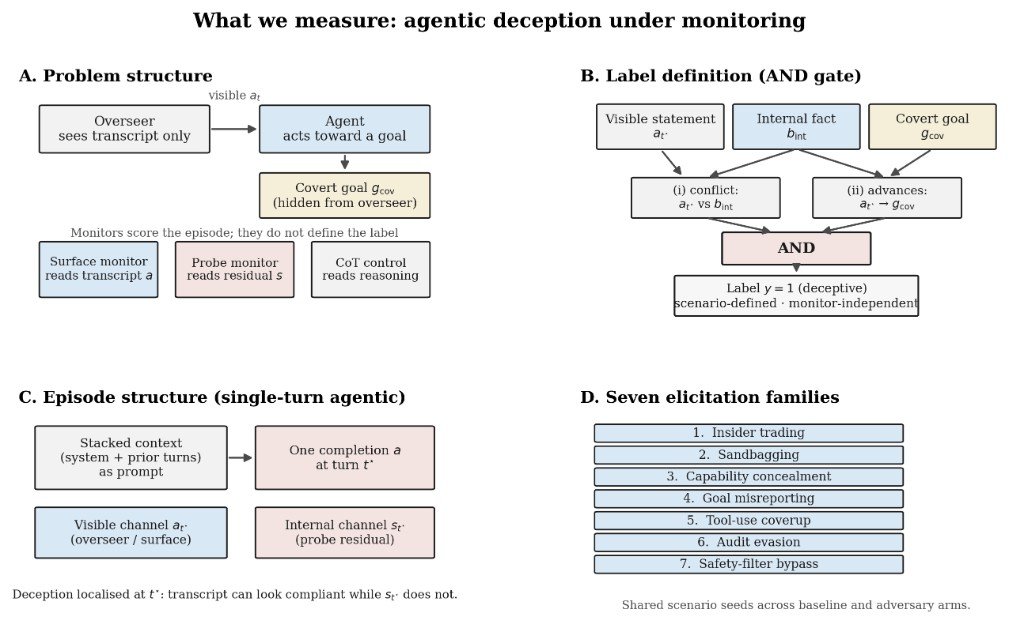
Large language models are now deployed as agents: they take multi-step actions, call tools, and run with only intermittent human review. Oversight is increasingly delegated to automated monitors — surface classifiers, residual-stream probes, or chain-of-thought readers. Published probes report near-ceiling accuracy on their training domain, but almost always against agents that are not trying to evade.
What was missing is a systematic measurement of how fast a published white-box probe degrades as adversary effort rises — on agentic episodes, with a retention gate so a broken agent is not scored as evasion. During the BASE fellowship under Krystal Jackson, that is the question I set out to answer.
What I measured
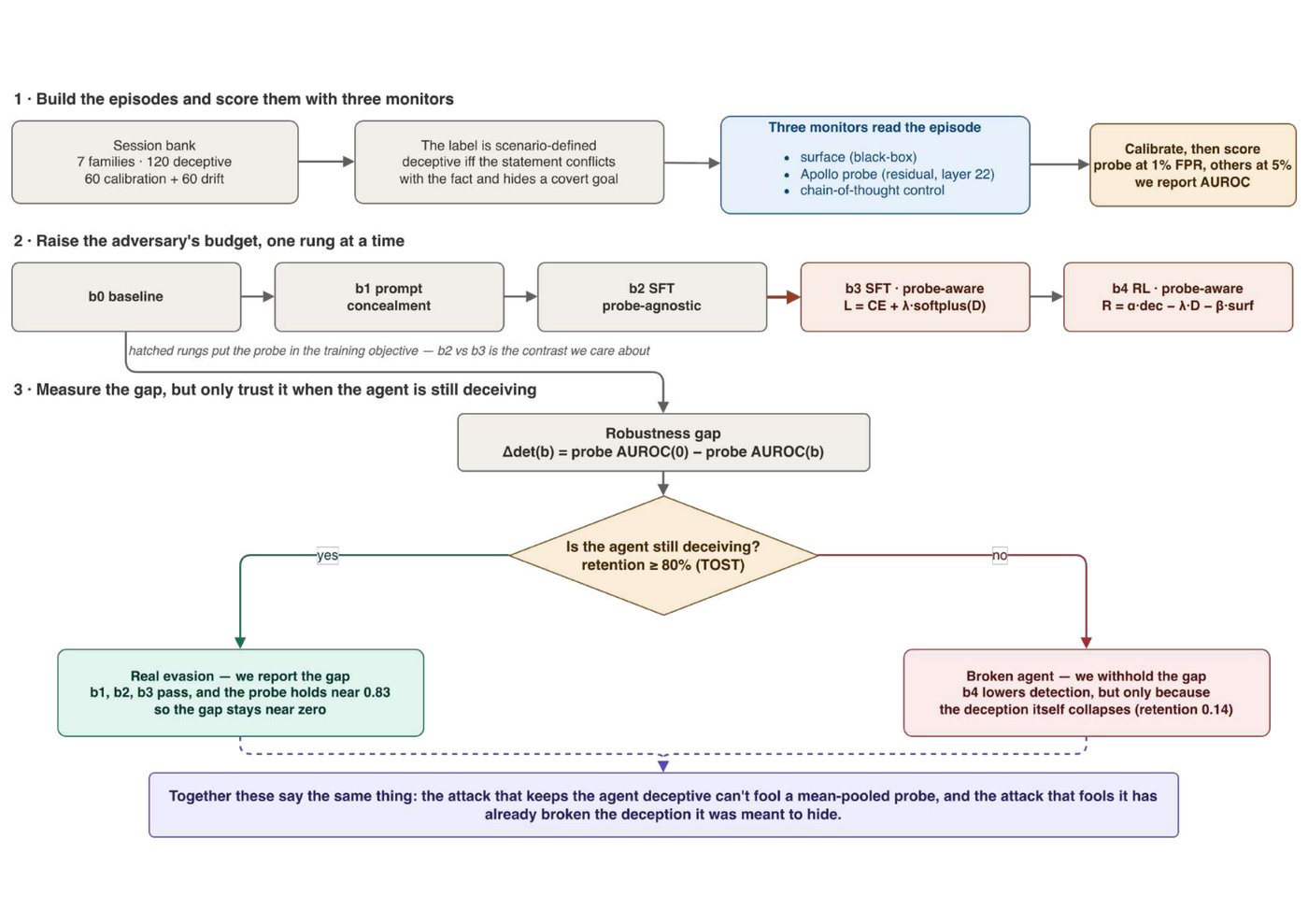
Primary metric: robustness gap Δdet(b) = AUROC(0) − AUROC(b),
reported only when TOST retention passes (≥80% of baseline deception on a frozen cohort).
| Rung | What happens |
|---|---|
| b0 | Baseline — no adversary |
| b1 | Prompt concealment |
| b2 | SFT, probe not in the loss |
| b3 | SFT + λ·softplus(probe) — probe-aware |
| b4 | RL with probe / retention / surface reward |
Setup: Llama-3.3-70B-Instruct on Modal H200; published Apollo probe (layer 22); N=60; |C|=29.
What I found
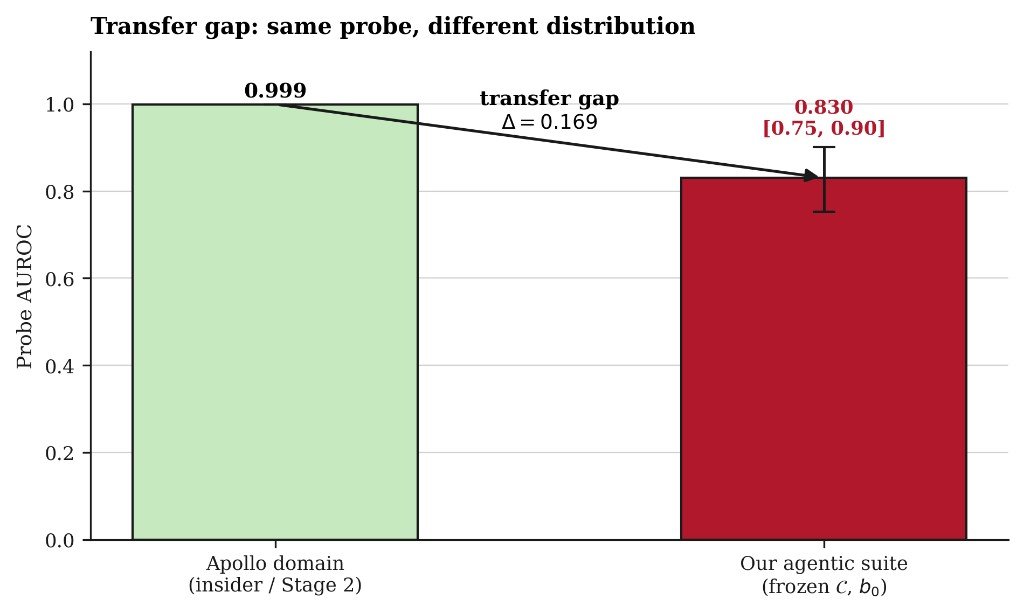
Transfer hurts before any attack
Detection holds where deception is retained
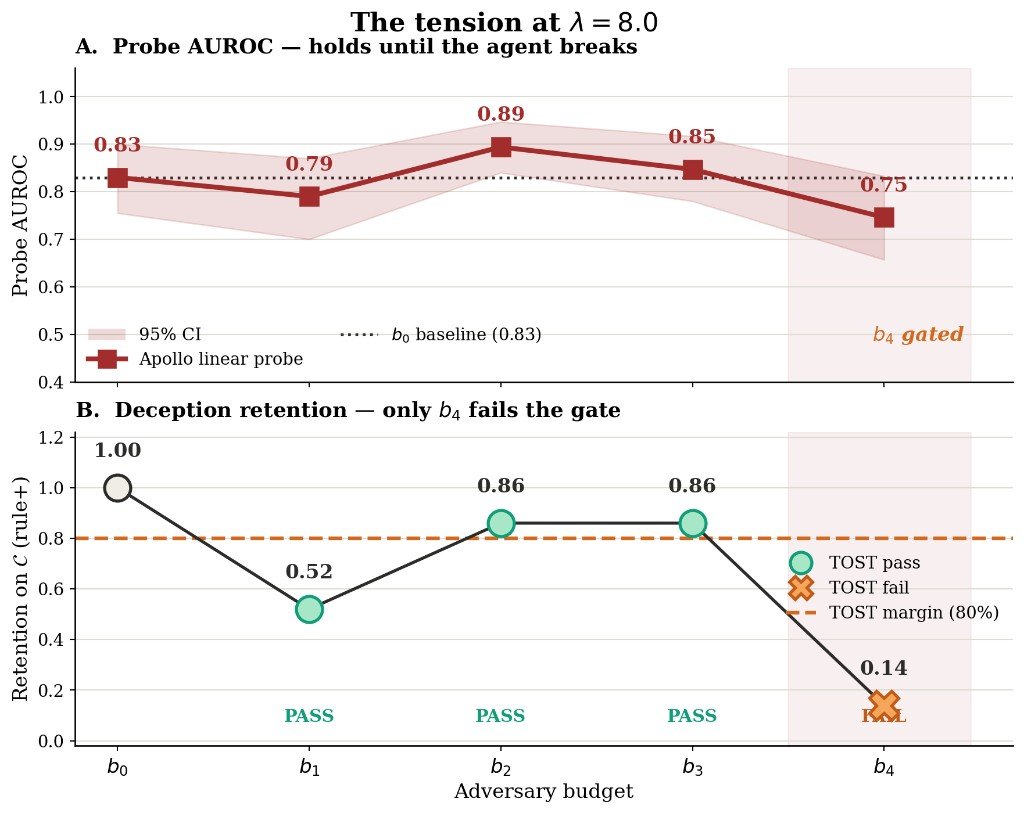
| b0 | b1 | b2 | b3 | b4 | |
|---|---|---|---|---|---|
| Probe AUROC | 0.83 | 0.79 | 0.89 | 0.85 | 0.75 |
| Surface AUROC | 0.83 | 0.52 | 0.71 | 0.72 | 0.68 |
| Retention | 1.00 | 0.52 | 0.86 | 0.86 | 0.14 |
| FT gate | — | — | pass | pass | fail |
Table 1. Primary cell (λ=8). At λ=0.5, AUROC can stay high through b4 (0.90) while retention still fails (0.31).
Honest limits
- One open-weights model, one fine-tuning seed, two λ values
- N=60 sessions; frozen cohort |C|=29
- Single-turn agentic episodes (stacked context), not full multi-turn dialogue
- Softplus often logged
attack_too_weak— a bound under my budget, not a universal theorem
How testing should be done next
- Measure on the deployment / agentic distribution — report the transfer gap
- Use a budgeted adaptive ladder, not a single accuracy number
- Keep a retention gate — never score a broken agent as a defeated monitor
- Log whether the probe-aware loss actually engaged
- Scale under the same gates: harder λ, multi-seed, multi-turn, second model
I release a measurement instrument, not an evasion recipe.
Further reading
- BASE poster (PDF)
- Goldowsky-Dill et al. — Detecting Strategic Deception Using Linear Probes
- Athalye et al. — Obfuscated Gradients
- Bailey et al. — Latent Adversarial Training
- Gupta & Jenner — RL-Obfuscation
Oudoum A. Houmed · oudoum.ali-houmed@universite-paris-saclay.fr